The Lobito Corridor after the photo opportunities: what it can and cannot carry
Financing has closed and Europe has taken the lead, but the railway's capacity is small next to Copperbelt output, and Zambia is still not connected
About this piece
- Outlook
- Copper, cobalt
- 20 August 2026
- 6 min
- lobito corridor, logistics, copper, cobalt, drc, zambia
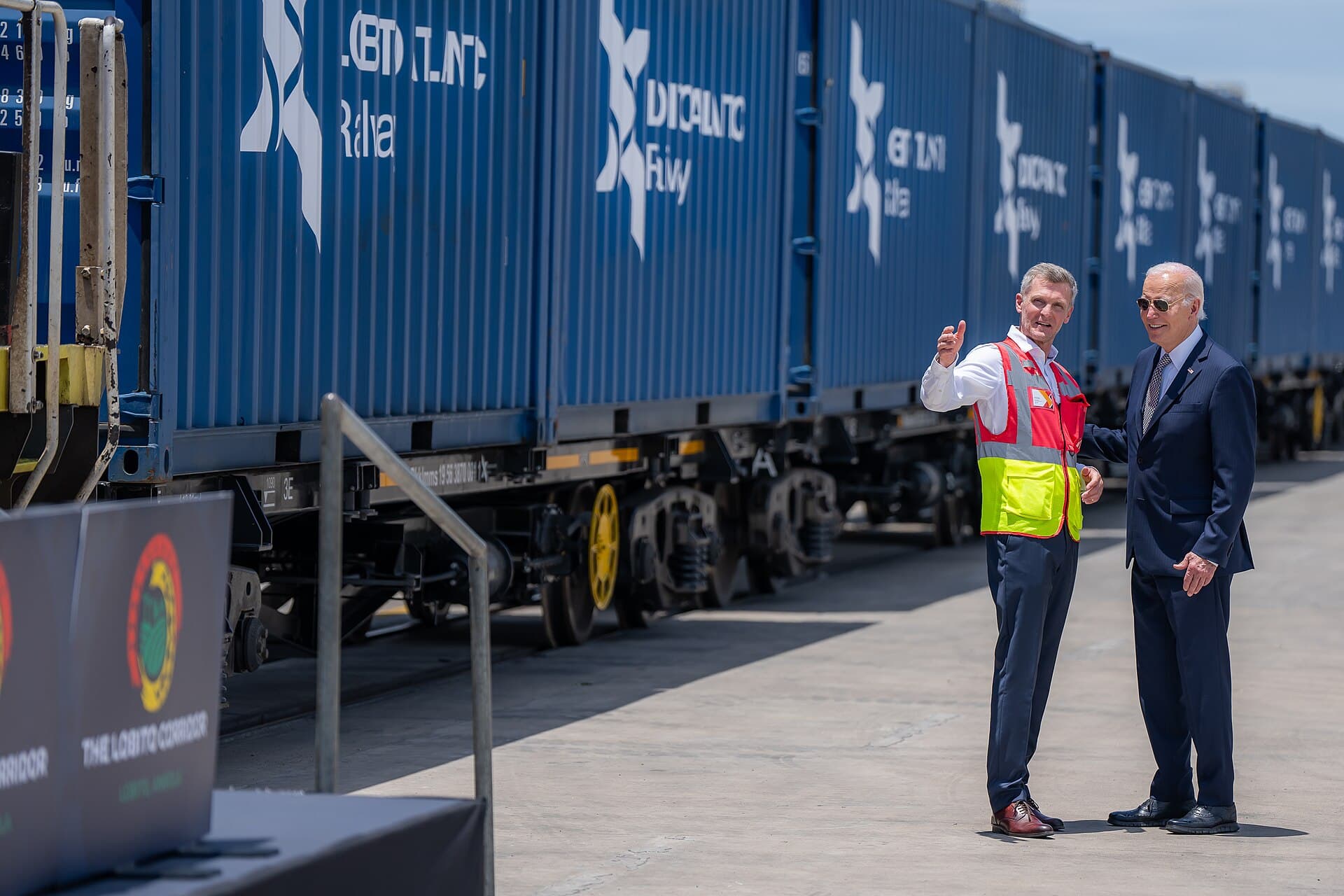
In December 2024 Joe Biden toured the Lobito port terminal, the high point of Washington's interest in the corridor. For a while the Lobito Corridor was presented as the West's answer to Chinese dominance of African minerals logistics. Twenty months later the politics have changed, but the project has moved on regardless. The question for miners in the Democratic Republic of Congo and Zambia is no longer whether Lobito will happen. It is how much of their output it can carry and when.
Where the project stands
The core asset is the Benguela railway. It runs 1,289km across Angola from the port of Lobito to Luau on the Congolese border and continues for another 450km to Kolwezi on the DRC network. Lobito Atlantic Railway (LAR), a consortium of Trafigura, Mota-Engil and Vecturis, won a 30-year concession in 2022, signed that November. It began operating in January 2024, and the concession runs to 2052.
The money is now in place. In December 2025 the US International Development Finance Corporation signed a $553m loan with LAR, with the Development Bank of Southern Africa adding $200m. Engineering News reported financial close on the DBSA–DFC package in early August 2026. The funds cover rehabilitation of the line and of the Lobito mineral port, with the aim of raising capacity roughly tenfold to 4.6 million tonnes a year. Engineering News' project tracker says LAR runs about 12 trains a week and plans 20 a week in 2027. It estimates the route could cut critical-mineral transport costs by around 30%.
Europe has taken over as the corridor's main sponsor. The EU ambassador to Angola, Rosario Bento Pais, told AFP in May that the EU, its member states, the European Investment Bank and private companies had committed about €2bn, just over a third of it as direct development aid. Total pledges across all backers exceed $2.7bn. In February, ministers from Angola, the DRC and Zambia met in Luanda and agreed to produce a corridor master plan and a joint investment platform. The EU, the African Development Bank, the World Bank and several bilateral partners attended.
The US role has shrunk. The Trump administration prefers bilateral minerals deals to multilateral projects, and on Zambia specifically Pais told AFP that "the United States is no longer in the picture, at least for now."
The capacity question
This is where expectations need adjusting. A 4.6Mt-a-year railway sounds substantial, and for a line that carried very little mineral traffic five years ago it is. Set against Copperbelt output, it is modest.
Official data reported by Reuters show that the DRC exported 696,725 tonnes of copper cathode in the first quarter of 2026 alone. That is a pace of roughly 2.8Mt a year, before counting cobalt hydroxide, concentrates, or the sulphuric acid and other reagents that mines import. LAR's chief executive, Nicholas Fournier, told Jeune Afrique last year that the railway would carry 240,000 tonnes of copper from Kolwezi to Lobito in 2026. On those figures Lobito would handle less than a tenth of Congolese copper exports this year. Most copper will keep going east and south by road and rail to Dar es Salaam, Durban, Walvis Bay and Beira.
That is not a failure. Competition among routes is valuable on its own terms. Every tonne that can credibly move west puts pressure on the rates and waiting times of the eastern and southern routes. For producers who now truck copper thousands of kilometres to Indian Ocean and South African ports, a working Atlantic option gives them bargaining power even if most cargo never uses it.
Weather, politics and the missing link
Three risks will decide how far Lobito goes.
Infrastructure resilience. In April heavy rain flooded bridges over the Halo and Cavaco rivers in Benguela province and forced LAR to suspend services, according to Reuters. The company switched some cargo to trucks while repairs were made. A line rebuilt in the 2010s after civil war damage is still vulnerable, and rehabilitation spending needs to go into drainage and bridges as well as track and rolling stock.
Zambia. Zambia is the corridor's largest missing piece. It produced 890,346 tonnes of copper in 2025 and wants 3Mt by 2031. Its northern mines are linked to Lubumbashi and Kolwezi by an old line that, according to AFP, would need about $4bn and 10 to 15 years to rebuild. With the US out of that project for now, the EU and the African Development Bank are looking at an interim road link from northern Zambia to the Angolan railhead at Luacano. Meanwhile China signed a $1.4bn deal in late 2025 to revive the Tazara line to Tanzania, giving Zambian exporters an upgraded route east. The Lobito and Tazara projects will compete for the same Zambian cargo.
Politics. Zambia's election on 13 August returned President Hakainde Hichilema with about 61% of the vote, according to the electoral commission, although the opposition says it will challenge the result in court. For Lobito, the result means continuity: his government has called the corridor a strategic priority and tied it to the 3Mt copper target. Angola votes in 2027. A new intergovernmental agency must still show that it can simplify customs and cut delays at the region's border posts. Those delays often matter more than the physical state of the track.
Our outlook
We expect Lobito to become a meaningful secondary route for Congolese copper and cobalt by the end of the decade, carrying a few million tonnes a year once the port and line reach the planned 4.6Mt. That would be enough to shift freight pricing across the region. It will not be enough to displace the eastern and southern corridors.
The bigger prize, a Zambian branch that brings North-Western Province mines within reach of the Atlantic, is a 2030s project at best. For mining companies, the practical steps are to test Lobito with trial volumes and to negotiate multi-route logistics contracts. They should also push the three governments on border processing, which costs far less than new rail and can be fixed sooner.
Western governments have also learned something from the Lobito story. A railway announced with presidential visits still needs years of maintenance, customs reform and financing to turn into a working route. Europe has taken on that less visible work, and whether the corridor succeeds will depend largely on it.
Sources
- Engineering News: Lobito Corridor railway project, Angola – update, 10 Jul 2026
- Engineering News: DBSA, US DFC reach $786m financial close on Lobito Corridor railway project, 04 Aug 2026
- TimesLIVE: US agency, consortium sign R9bn loan for Angola railway revamp, 19 Dec 2025
- eNCA / AFP: Lobito Corridor: Africa's mega-project facing delivery test, 07 May 2026
- Mail & Guardian: Lobito Corridor: A new line for trade and investment, 19 Feb 2026
- TimesLIVE: WATCH | Trains through Angola's Lobito corridor suspended due to floods, 14 Apr 2026
- CNBC Africa / Reuters: Congo bans copper and cobalt concentrates exports, official order says, 06 Aug 2026
- Jeune Afrique: « En 2026, Lobito Atlantic Railway transportera 240 000 tonnes de cuivre de Kolwezi à Lobito », déclare Nicholas Fournier, 26 Aug 2025
- Miningmx: Zambia courts investors for copper output tripling, 10 Mar 2026
- Al Jazeera: Zambia's President Hakainde Hichilema wins second term, 18 Aug 2026
Photo: US President Joe Biden tours the Lobito port terminal with Lobito Atlantic Railway's chief operating officer in December 2024. The White House, Wikimedia Commons, Public domain.
Was this useful?
Discussion
Loading comments…